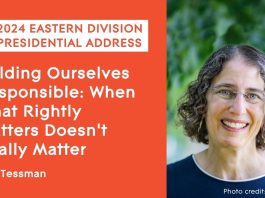

Asha Bhandary is Professor of Philosophy at the University of Iowa. She works in social and political philosophy as a feminist philosopher. Through her books and articles, she advances a theory called intersectional liberalism, which is a liberal political theory that values personal autonomy while addressing the human needs for care and belonging. She also serves as chair of the APA Committee on Asian and Asian American Philosophers and Philosophies, where one of her main initiatives has been to support Asian American feminism.
What is your work about?


In Being at Home: Living Autonomously in an Unjust World, I reimagine liberal philosophy through the lens of intersectionality, showing how race, gender, and caregiving relationships must reshape our understanding of autonomy. As the first care-responsive theory of liberalism to address intersectionality and racism, it makes a unique contribution, reorienting debates about autonomy in liberalism, multiculturalism, and feminist care theory when the “normative subject”—the subject whose experiences informed the idealizations embedded in the conception of the person in the theory—is a biracial woman of color, an Asian woman living in America’s heartland, and a mother. Doing so reveals that attending to the values of belonging and care is necessary if we are to build a society in which women of color can live autonomously.
The book’s title, Being at Home, also refers to one of the central concepts of the book. Being at home requires access to core rights and liberties and to one’s valued relationships without fear of disruption. It characterizes the combined political, social, and cultural standing of some people in a society. Whereas being at ease might be achieved through many different paths, being at home in the technical sense this book advances is a socio-political good that includes necessary external conditions.
How does it fit in with your larger research project?
My research program overall builds the fact that humans need to receive care to survive into a theory of distributive justice. It emphasizes that if we are to receive care, someone must provide care for us, and it places the people who are socially scripted into being caregivers at the center of the theory.
I have been revising liberalism to include our need for care since my 2010 Hypatia article, “Dependency in Justice: Can Rawlsian Liberalism Accommodate Kittay’s Dependency Critique?” In my first monograph, Freedom to Care (2020), I developed a liberal theory of justice, called the theory of liberal dependency care, that establishes parameters for the provision and receipt of care within liberal societies. That book’s contribution was largely a form of nonideological ideal theory that focused on reformulating central concepts and presenting a justification to include care within liberalism. Being at Home is about living in the world that is still unjust with respect to care. It begins from the reflection that we non-white women who are really doing what we love are generally the most autonomous people you can find, and it reorients political theory from that point, to insert us into the theory as the normative subjects and then to diagnose injustices, such as the greater burden of stress we bear, or the outsider status that is repeatedly applied to Asian Americans.
How do you relate your work to other well-known philosophies?
This work is in conversation with diverse lineages. It builds on a tradition of theorizing about justice in political philosophy while also building from Asian American philosophy, Black feminist thought, Latinx feminism, feminist autonomy theory, and the reproductive justice framework, all to yield intersectional liberalism. I engage these literatures as I advance a new direction for liberal political theory. Like Charles Mills’s work, it engages in racial critique of liberalism. The project is also located in a lineage with Asian American philosophers including Falguni Sheth, David H. Kim, and Ronald Sundstrom.
What directions would you like to take your work in the future?
I am beginning a new project on second persons that considers the biological, social, and political dimensions of second personhood. My project evaluates the significance of these facts for theories of justice, thereby rejecting the patriarchal construals which mask these facts in ideologies about motherhood. The resultant research project begins from the idea of the second person, which is the sense in which we are each a “you,” and which includes the claim that we exist only because of one who came before us, whose interaction with us develops us into a person.
How is your work relevant to historical ideas?
Western political philosophers have been asking questions about the nature of the just society for a long time. For instance, Plato’s Republic includes a discussion of specialization and care work in the process of evaluating the nature of the just society. My work is located in the tradition of political philosophy that asks how the division of benefits and burdens should be arranged in a society, who counts. It does so in way that is in dialogue with diverse texts and traditions, taking the facts of oppression to be a necessary part of that inquiry.
What effect do you hope your work will have?
I hope my work will help to move us toward a just society in which people’s needs for care are met while women of color can be full claimants. If successful, it will contribute to the undoing of white entitlement and patriarchal habits of claiming. It will do so by shifting the justificatory burden of proof. I also hope it will make a theoretical home for some people whose experiences have not been articulated.
If you could have a one-hour conversation with any philosopher from any time, who would you pick and what topic would you choose?
I have been curious about John Stuart Mill’s mother for decades. Although he explains his childhood at length in his autobiography, we learn little about his mother. Therefore, it would be interesting to talk with him, not only about his account of self-determination, upon which I build, but to also ask some probing questions about his mother. However, with a new edition of On Liberty recently published that recognizes Harriet Taylor Mill as the co-author of that book, I now think this precious hour would be more illuminating as a conversation with Harriet Taylor Mill to discuss freedom in the context of oppressive social expectations, then segueing into a woman-to-woman analysis of the mothers of our husbands.
Where is your favorite place you have ever traveled and why?
When I was a sophomore in college, I took off a term during my studies at Stanford, where I had assumed I would pursue a major in the sciences. Finding myself dissatisfied with the intellectual engagement of that pursuit, I spent the winter at a familial home in central Finland, where I stayed with my second cousin. Although I was not yet studying philosophy, I packed Rousseau’s Emile and read it during what turned out be an ideal period in my life—I went cross-country skiing alone every day, taking care to avoid moose while noting their tracks, took evening walks with my cousin and her one-year-old baby, endeavored to improve my Finnish, and had time to think.
Although I had visited Finland many times before that winter, and many times since, that time in central Finland will always be a self-contained capsule of experience with a stillness that belied the significance of the internal events which have proved to be of great significance to the shape of my life.